Soil that feels firm on the surface can still settle under your floors. Here is how to test compaction before you build on it.

A building’s long-term performance depends not only on its structural design but also on the quality of the ground supporting it. Poorly compacted soil filling, plinth filling or foundation backfilling can contribute to settlement, uneven floors, pavement damage and other construction problems. A proper soil compaction test for building construction helps verify whether the placed soil has achieved the density required by the project specification before the next construction activity begins.
Simply filling an area with soil and running a roller over it does not guarantee adequate compaction. The filling material, moisture content, layer thickness, compaction equipment and field testing all play important roles.
Key takeaways
Soil filling and soil compaction are two different construction activities.
Inadequate compaction can contribute to settlement of plinth filling, backfill, floors and pavements.
Laboratory Proctor tests establish reference moisture-density relationships.
Field density tests help verify the actual compaction achieved at the construction site.
Soil compaction should be checked before the completed layer is covered by subsequent construction.
Filling or plinth work under way in Kolkata or West Bengal? Ask our engineers to plan the compaction testing.
What Is Soil Compaction and Why Is It Important?
Soil compaction is the process of mechanically increasing the density of soil by reducing the air voids between soil particles. It is generally achieved using suitable equipment such as rollers, plate compactors and mechanical rammers.
Proper compaction improves the engineering performance of placed soil by reducing the potential for further compression under the intended loading conditions.
In building construction, soil compaction is particularly important for:
Site filling and ground preparation.
Plinth filling before floor construction.
Backfilling around foundations.
Preparation of internal roads and parking areas.
Industrial floors and external paved areas.
How does soil compaction improve ground performance?
Loose soil may contain a relatively large volume of voids. When loads are subsequently applied, the soil particles may rearrange, causing additional compression and settlement.
Adequate compaction helps reduce this potential by increasing soil density. However, the performance of compacted soil also depends on its composition, moisture condition, drainage, loading and the quality of the underlying ground.
It is important to understand that compaction does not automatically eliminate settlement arising from weak natural soil, compressible strata or unsuitable foundation conditions.
Why does moisture content matter?
Water plays an important role during soil compaction because it helps soil particles rearrange under the applied compactive effort.
For a particular soil and specified laboratory compaction procedure, two important parameters are determined:
Maximum Dry Density (MDD): The maximum dry density achieved under the specified laboratory compaction procedure.
Optimum Moisture Content (OMC): The moisture content corresponding to that maximum dry density under the same procedure.
These values provide reference parameters for controlling field compaction. They vary according to soil characteristics and the laboratory test procedure.
Too little or too much moisture can reduce the effectiveness of compaction.
What Happens When Soil Is Not Properly Compacted?
Inadequate compaction may not produce visible problems immediately. Distress can develop later when the filled ground is subjected to building loads, floor loads, vehicle movement or changes in moisture conditions.
Settlement of filled ground and plinth areas
Poorly compacted filling material may undergo further compression after construction.
This can result in settlement of the plinth area or floor support, potentially causing:
Uneven floor levels.
Gaps near skirting and wall junctions.
Damage to floor finishes.
Distress around service connections.
Cracks in floors and pavements
When the supporting soil beneath a floor slab or pavement settles unevenly, the slab may experience additional stresses.
Depending on the slab design, thickness, reinforcement, loading and support conditions, this may contribute to cracking or differential movement.
However, cracks can also arise from shrinkage, thermal effects, inadequate detailing and other construction-related causes. Their actual cause should be investigated rather than assumed.
Differential settlement
Differential settlement occurs when different portions of a structure or its supporting ground settle by different amounts.
For example, one portion of a filled area may be properly compacted while another remains loose. Variations in fill depth, soil material and moisture conditions can create non-uniform support.
Differential movement can affect floors, partitions, pavements and, in some circumstances, foundations or connected structural elements.
Problems with underground services
Settlement of backfilled trenches can affect buried pipelines, drainage lines and other underground services.
Depending on the extent of movement and installation details, this may result in joint displacement, changes in pipe gradients, leakage or damage to surrounding surfaces.
Where Is Soil Compaction Required in Building Construction?
The compaction requirement depends on the construction activity, soil type, design and project specifications.
Site filling and ground preparation
Low-lying or uneven sites may require filling before construction. The suitability of the filling material and the condition of the original ground should be assessed before placement.
Simply filling a plot to the required level does not establish that the resulting ground is suitable for the proposed construction.
Plinth filling before floor construction
Plinth filling supports the floor build-up in many building projects. Inadequately compacted fill can settle after the floor is completed.
The material should be placed and compacted in controlled layers, with appropriate field verification as specified by the project.
Foundation backfilling
Backfilling around foundations should be carried out carefully.
The selected material, moisture condition, equipment and available working space must be considered. Heavy compaction equipment should not be operated close to foundations or retaining elements without considering the possibility of excessive lateral pressure or construction damage.
Roads, parking areas and industrial floors
Ground preparation is important wherever the finished surface will carry repeated traffic, vehicle loads, equipment or storage loads.
The required compaction and testing criteria should be specified according to the intended use.
How Is Soil Compaction Tested for Building Construction?
A reliable soil compaction test for building construction generally involves laboratory testing to establish reference properties and field testing to assess actual site conditions.
The appropriate test method depends on soil characteristics, project specifications and site conditions.
Laboratory Proctor Compaction Test
The Proctor compaction test establishes the relationship between moisture content and dry density for a soil sample under a specified laboratory compaction procedure.
Two commonly used procedures are:
Standard Proctor or light compaction test.
Modified Proctor or heavy compaction test.
The choice of procedure should match the applicable project specification and intended application.
The test helps determine the Maximum Dry Density (MDD) and Optimum Moisture Content (OMC) of the tested soil.
These values are subsequently used as reference parameters for field compaction control.
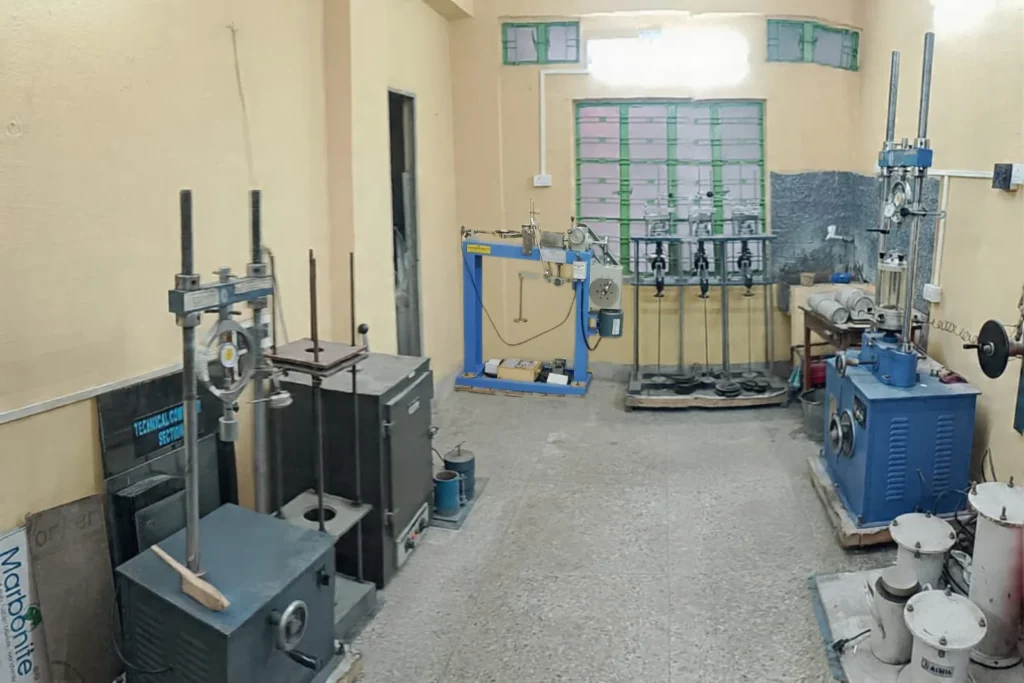
Field Density Test by Sand Replacement Method
The sand replacement method is commonly used to determine the in-situ density of compacted soil.
A small excavation is made in the compacted layer. The volume of the excavated hole is determined using calibrated sand, and the mass of the excavated soil is measured.
The field dry density is calculated using the measured soil mass, hole volume and moisture content.
The result can then be compared with the relevant laboratory reference density and the project acceptance criteria.
Core Cutter Method
The core cutter method determines the in-situ density of suitable soils by driving a known-volume cylindrical cutter into the ground and measuring the mass of the soil recovered.
It is generally suitable for cohesive soils that can be sampled without significant disturbance.
It may not be suitable for gravelly, stony or very hard soils, or materials that cannot be sampled properly using the cutter.
The test method should therefore be selected according to the soil being investigated.
How Is Percentage Compaction Calculated?
The percentage of compaction is commonly expressed as:
Percentage Compaction = (Field Dry Density / Laboratory Maximum Dry Density) × 100
The measured field dry density is compared with the relevant laboratory MDD to determine the percentage achieved.
The required acceptance percentage must come from the approved project specification or applicable design requirements. There is no single universal acceptance value suitable for every building project.
What Is the Difference Between a Proctor Test and a Field Density Test?
Both tests are important, but they serve different purposes.
| Parameter | Proctor Compaction Test | Field Density Test |
|---|---|---|
| Location | Laboratory | Actual construction site |
| Main purpose | Establishes moisture-density relationship | Determines in-situ density |
| Key output | MDD and OMC | Field wet and dry density |
| Application | Provides reference values | Verifies field compaction |
| Timing | Before or during construction quality planning | During placement and compaction |
| Limitation | Represents the tested sample and procedure | Represents the particular test location |
A laboratory result alone cannot establish that soil at every location on site has been properly compacted.
The field density test provides the necessary verification of actual construction conditions.
How Do You Ensure Proper Soil Compaction at Site?
A systematic approach helps reduce the possibility of inadequate compaction.
Step 1: Check the filling material
The material should be assessed for suitability before it is used.
Excessive organic matter, unsuitable debris, highly variable material or other undesirable constituents may affect ground performance.
The geotechnical requirements should determine whether the proposed material is acceptable.
Step 2: Determine the moisture condition
The soil should be conditioned towards the appropriate moisture range established through laboratory testing.
Water should be added uniformly where required. If the material is excessively wet, suitable drying or other corrective measures may be necessary.
Step 3: Place soil in controlled layers
Soil should be spread in layers suitable for the selected equipment and material.
Excessively thick layers may result in inadequate compaction in the lower portion, even when the surface appears firm.
The permitted loose layer thickness should be specified based on soil type, equipment capability and project requirements.
Step 4: Select suitable compaction equipment
Different equipment is suitable for different soil types and site conditions.
| Equipment | Typical application |
|---|---|
| Smooth drum roller | Suitable granular and some mixed materials |
| Sheep-foot roller | Suitable cohesive soils |
| Vibratory roller | Suitable granular materials where vibration is appropriate |
| Plate compactor | Restricted areas and smaller granular fill zones |
| Mechanical rammer | Trenches and confined areas |
Equipment selection should consider the material, access, layer thickness, nearby structures and potential vibration effects.
Step 5: Conduct field density testing
Field density testing should be undertaken at specified locations and frequencies.
If a test result does not meet the acceptance criteria, the affected area should be investigated and corrective action taken.
Depending on the cause, this may involve moisture adjustment, further compaction, removal and replacement of unsuitable material, or a revised construction method.
Step 6: Maintain quality records
Test reports should identify:
Test location.
Depth or compacted layer.
Soil description.
Moisture content.
Field density.
Laboratory reference value.
Percentage compaction.
Acceptance or corrective action.
This documentation helps establish whether the work was checked before the next construction stage.
What Are the Common Soil Compaction Mistakes?
Some frequently encountered construction quality problems include:
Placing fill without checking whether the material is suitable.
Compacting excessively thick soil layers.
Using inappropriate equipment for the soil type.
Ignoring moisture content during compaction.
Assuming that repeated roller movement guarantees adequate density.
Testing only convenient locations instead of following a planned testing arrangement.
Covering a completed layer before obtaining the required test results.
Failing to investigate and correct non-compliant test results.
One important point is that surface firmness is not a reliable substitute for field density testing. A surface may feel hard while deeper portions of the same layer remain inadequately compacted.
What Does It Cost to Ignore Soil Compaction Testing?
The cost of preventive quality control should be considered against the possible cost and disruption associated with correcting defects after construction.
| Before construction | After settlement or distress |
|---|---|
| Laboratory compaction testing | Additional investigation to identify the cause |
| Controlled filling and compaction | Removal of affected floor or pavement sections where necessary |
| Planned field density testing | Repair and reinstatement work |
| Early correction of non-compliant layers | Possible disruption to building use |
| Documented quality control | Greater uncertainty about concealed ground conditions |
The actual cost of corrective work depends on the extent of settlement, accessibility, building use, location of services and the repair method required.
Not every poorly compacted area will cause structural damage. However, failure to verify compaction can leave avoidable uncertainty in the ground supporting floors, pavements and other construction elements.
What Should You Watch For in Kolkata and West Bengal?
Kolkata and surrounding districts include sites with varied ground conditions. Some plots may involve previous filling, low-lying land, variable soil strata or relatively high groundwater conditions.
However, these characteristics cannot be assumed for every property. Site-specific investigation is essential. Read more about soil conditions in West Bengal.
Particular attention may be required when:
Construction is proposed on previously filled land.
The thickness and composition of existing fill are unknown.
Plinth levels are being raised through substantial filling.
Backfilling is required near foundations or retaining structures.
Water ingress or drainage conditions may affect the compacted material.
Industrial floors or paved areas will carry significant operational loads.
A soil compaction test for building construction should be considered as part of a broader geotechnical quality-control process, rather than an isolated laboratory exercise. See why soil testing for building construction matters before design.
For sites involving significant filling or uncertain ground conditions, the underlying soil profile and proposed loading should also be evaluated.
Why Does Professional Geotechnical Evaluation Matter?
Soil compaction is a construction quality-control activity, but the correct testing and acceptance approach requires engineering judgement.
A geotechnical consultant can help assess:
Whether the proposed filling material is suitable.
Which laboratory compaction procedure is appropriate.
What field density test method should be used.
Whether the testing arrangement adequately covers the work.
Whether the achieved density meets the project specification.
What corrective action may be required when results are unsatisfactory.
BS Projects & Engineers Pvt. Ltd. (BSPEPL), Kolkata, provides geotechnical investigation and related engineering consultancy services. Its work includes soil investigation, laboratory testing coordination, field testing and geotechnical recommendations for construction projects.
The objective is to help project teams make informed decisions about ground conditions before subsequent construction activities conceal the work. Learn how our geotechnical investigation process works, or see our soil testing and geotechnical investigation services in Kolkata.
Frequently Asked Questions
Why is soil compaction important before building construction?
Soil compaction improves the density and engineering performance of placed fill. Inadequate compaction can allow further compression under loading, potentially causing settlement of floors, pavements or backfilled areas. Proper compaction and field verification help establish whether the prepared ground meets the project requirements.
What happens if soil is not properly compacted?
Inadequately compacted fill may settle after construction. Depending on the location and loading, this can result in uneven floors, pavement distress, damage to buried services or differential movement. The actual consequences depend on soil characteristics, fill thickness, underlying strata and construction conditions.
How do you check soil compaction at a construction site?
Field density testing is commonly used to check compaction. Sand replacement and core cutter methods are two recognised approaches, subject to soil suitability. The measured field dry density is compared with the relevant laboratory maximum dry density and the acceptance criteria specified for the project.
What is the difference between the Proctor test and the field density test?
The Proctor test is performed in a laboratory to establish the relationship between moisture content and dry density. The field density test measures the density achieved at an actual construction location. Both are required for a meaningful compaction-control process because laboratory reference values alone do not verify site execution.
What are Maximum Dry Density and Optimum Moisture Content?
Maximum Dry Density is the maximum dry density obtained for a soil under a specified laboratory compaction procedure. Optimum Moisture Content is the corresponding moisture content. These parameters provide reference values for controlling field compaction. They vary with soil characteristics and the laboratory test procedure.
Can poor soil compaction cause cracks in buildings?
Poor compaction of fill can contribute to settlement and may cause cracks in supported floors, pavements or other components. However, cracks can also result from structural movement, shrinkage, thermal effects, foundation settlement and other causes. Proper investigation is necessary before identifying the cause. If a building already shows cracks, a structural audit can identify the cause.
Is soil compaction testing necessary for plinth filling and backfilling?
Testing is important where the project specification requires controlled compaction of plinth fill or backfill. The testing method, frequency and acceptance criteria should reflect the material, construction purpose and site conditions. Particular attention is needed where settlement could affect finished floors, services or adjacent structures.
How much compaction is required before laying a building foundation?
There is no single compaction percentage applicable to every foundation or site. The requirement depends on the soil, fill material, loading, foundation design and project specifications. The geotechnical and structural design requirements should establish the appropriate acceptance criteria before construction proceeds.
Conclusion: Verify Soil Compaction Before Proceeding with Construction
A building’s long-term performance depends not only on its visible structural components but also on the ground supporting the construction.
Poorly compacted filling can create settlement-related problems that may become apparent only after floors, pavements and other components have been completed.
A properly planned soil compaction test for building construction, supported by suitable laboratory reference testing and field density verification, helps identify construction-quality problems at an earlier stage.
Do not treat soil filling as completed work until the required compaction has been verified.
Planning filling, plinth or foundation work? Talk to our geotechnical engineer.
WhatsApp / Call: 98304 83074 | 98307 37826 · Email: hello@bspepl.com
Learn more about our soil testing and geotechnical investigation services in Kolkata.