Plastering over cracks without finding their cause can hide damage that keeps growing. Assess first, then repair.
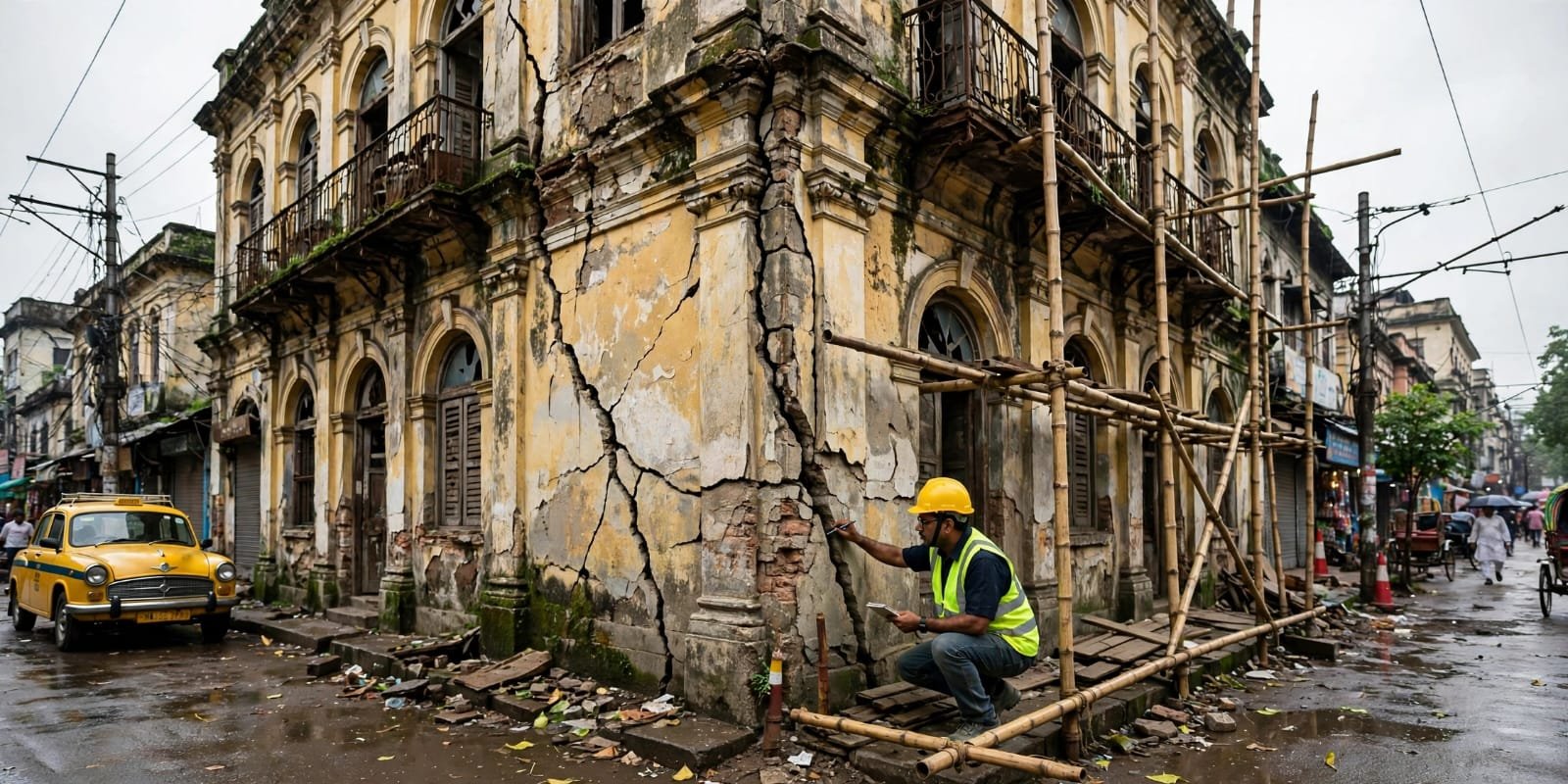
Repair of an old building should begin with a proper assessment of its structural condition, not simply with plastering cracks, applying waterproofing or replacing damaged concrete. Without identifying the underlying cause of deterioration, repair work may conceal serious defects, fail prematurely or leave structural risks unaddressed. A systematic structural assessment helps building owners understand what needs repair, why it has deteriorated and which intervention is appropriate.
For owners, housing societies, developers and contractors, the important question is not merely how to repair an old building, but whether the proposed repair is suitable for the building’s actual condition.
Key takeaways
- Visible cracks, dampness and concrete spalling are symptoms; their causes must be investigated.
- Structural assessment should precede major repair, rehabilitation or strengthening.
- NDT results are useful evidence but individual tests cannot independently certify overall structural safety.
- Additional floors, changed building use and heavy equipment can alter the demands on an existing structure.
- A technically appropriate repair plan should address the cause of deterioration as well as the visible damage.
Planning repairs to an old building? Get it assessed first by our structural engineers.
Why Repair of an Old Building Should Begin with Structural Assessment
Buildings deteriorate over time due to environmental exposure, moisture ingress, reinforcement corrosion, material ageing, foundation movement, poor construction practices and inadequate maintenance. Alterations made during the building’s service life can also affect its structural behaviour.
When owners notice cracks, leakage, exposed reinforcement or falling plaster, the immediate response is often to appoint a contractor for repair. However, the same visible symptom can have different underlying causes.
For example, a crack may be associated with shrinkage, temperature effects, settlement, overloading, corrosion-induced expansion or structural movement. These conditions do not necessarily require the same repair method.
Similarly, applying a new plaster layer over deteriorated concrete may improve the appearance temporarily without addressing corrosion or loss of concrete section beneath it.
A structural assessment helps establish the condition of the building, identify areas requiring further investigation and determine whether the proposed intervention is appropriate.
The correct sequence is assessment, diagnosis, repair design and controlled execution—not repair first and investigation later.
Common Warning Signs That an Old Building Needs Assessment
Not every defect indicates structural danger. However, certain signs should not be ignored, particularly when they are recurring, progressive or present in important structural members.
Cracks in beams, columns, slabs and walls
Cracks should be examined for their location, orientation, pattern, width, extent and possible change over time.
Cracks in structural members require particular attention. Their significance depends on the structural system, loading, material condition and the mechanism that caused them.
Repeatedly filling a crack without investigating its cause may result in the crack reappearing.
Concrete spalling and exposed reinforcement
Spalling refers to the breaking away or loss of concrete cover. When reinforcement becomes exposed, it may be vulnerable to moisture and corrosion.
Corrosion products can expand and exert pressure on surrounding concrete, contributing to cracking and further spalling. In advanced cases, reinforcement may lose cross-sectional area and bond effectiveness.
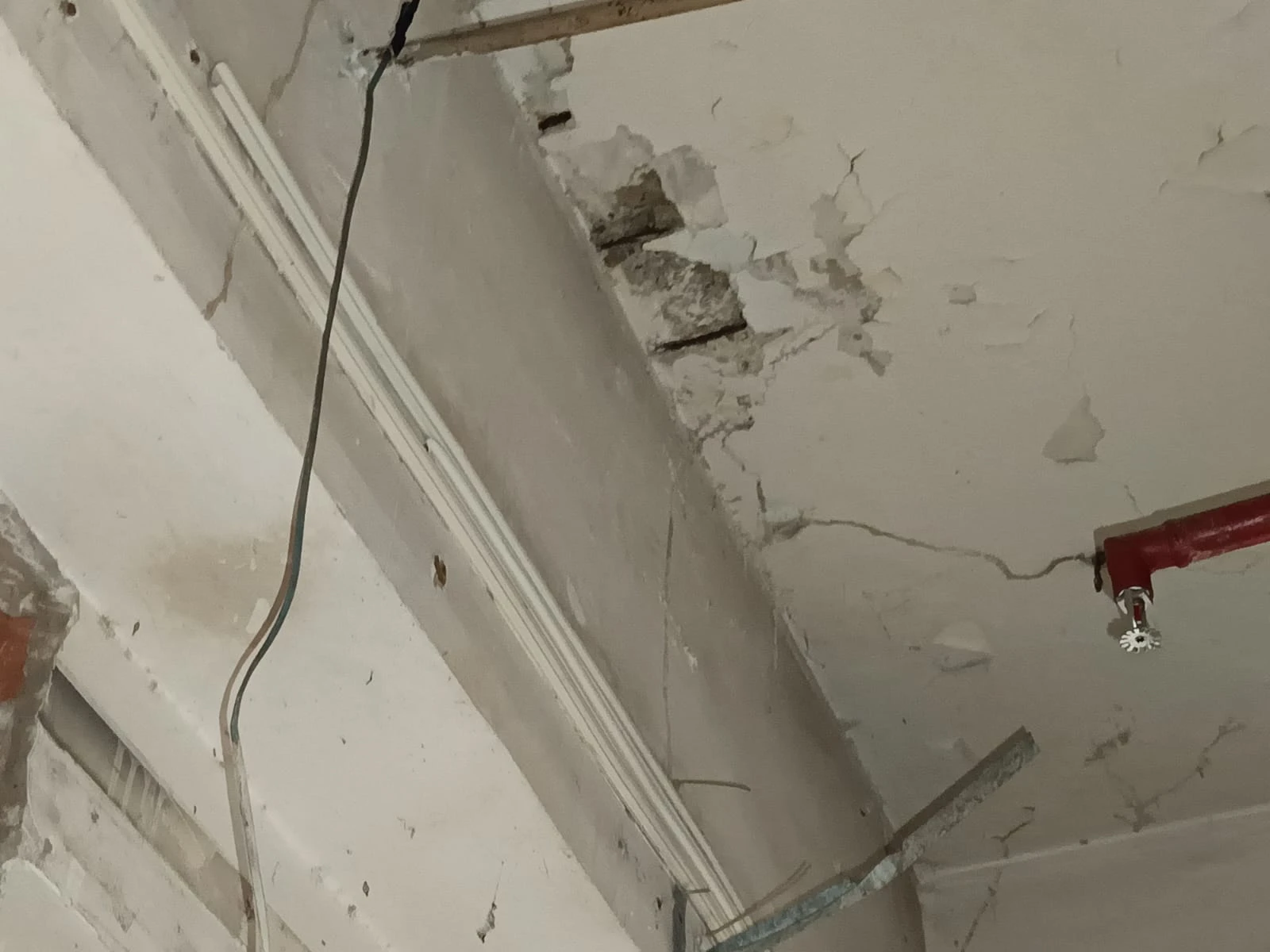
Rust staining and reinforcement corrosion
Rust stains, longitudinal cracks along reinforcement and delamination may indicate corrosion-related deterioration.
The extent of corrosion cannot reliably be determined from surface appearance alone. Further investigation may be necessary to understand the condition of the reinforcement and surrounding concrete.
Persistent dampness and water leakage
Water ingress can contribute to concrete deterioration, reinforcement corrosion, damage to finishes and deterioration of other building materials.
The source of water should be identified. It may be associated with plumbing leakage, roof waterproofing failure, defective drainage, external water penetration or other site-specific conditions.
Settlement, tilting or unusual movement
Uneven settlement, noticeable tilting, changes in floor levels or recurring cracks may indicate movement requiring investigation.
Foundation-related problems should not be assumed from cracks alone. The building, foundation system, ground conditions, drainage and neighbouring construction may all need consideration.
Unauthorised alterations or additional loading
Removing walls, cutting structural members, changing room layouts, adding floors, installing water tanks or introducing heavy machinery can change the demands on an existing structure.
Before such work is undertaken, the existing structural system and its capacity should be evaluated by a competent structural engineer.
Why Repairing an Old Building Without Assessment Can Be Dangerous
The main risk is that a repair may address the visible symptom while leaving the underlying cause unresolved.
Covering cracks without identifying their cause
Filling and repainting a crack may improve the appearance of a wall or ceiling. However, if the crack is associated with continuing movement, settlement, overloading or structural distress, cosmetic treatment will not resolve the underlying problem.
The cause and significance of the crack should be assessed before deciding on the repair method.
Covering corroded reinforcement without proper investigation
Simply removing loose concrete, applying a coating and covering the reinforcement again may not be sufficient.
The engineer may need to assess the extent of corrosion, remaining reinforcement section, concrete condition, bond, exposure and structural implications before specifying a repair system.
Repairing concrete without checking the extent of deterioration
Visible spalling may represent only part of a larger deterioration zone. Concrete that appears intact at the surface may also require examination where there is evidence of delamination or corrosion.
The extent of removal and reinstatement should be based on an appropriate assessment and repair specification.
Removing or altering structural components
Removing a column, beam, load-bearing wall, slab portion or other structural element without engineering review can affect load transfer and structural stability.
Even apparently minor modifications may have consequences depending on the structural arrangement.
Adding floors or heavy loads without checking capacity
An old building should not be assumed capable of carrying additional floors, rooftop structures, water tanks, machinery or other heavy loads simply because it has remained standing for many years.
The existing structure, foundations and relevant loading conditions must be evaluated before additional loading is introduced.
Selecting unsuitable repair materials or methods
Repair materials must be compatible with the existing substrate and the intended structural or durability performance.
The choice depends on the nature of the defect, concrete condition, exposure, reinforcement condition, access, preparation and execution requirements.
A product marketed as a concrete repair material is not automatically suitable for every structural repair.
How to Assess an Old Building Before Repair
A systematic assessment generally involves several stages. The extent of investigation should be proportionate to the building’s condition, importance, structural system and intended use.
Stage 1: Review available documents and building history
Collect available structural and architectural drawings, previous repair records, construction details and information about alterations.
The assessment should also establish:
- Approximate age and construction type.
- Number of floors and present use.
- History of leakage, settlement, cracks or repairs.
- Changes in occupancy or loading.
- Addition of floors, tanks, equipment or other structures.
- Previous fire, flood, impact or earthquake damage, where applicable.
If drawings are unavailable, the existing structural arrangement may need to be established through site investigation and measurements.
Stage 2: Conduct a visual condition survey
A qualified engineer should inspect the accessible building components and document visible distress.
This may include:
- Mapping cracks and damaged areas.
- Recording concrete spalling and exposed reinforcement.
- Observing leakage, dampness and corrosion signs.
- Checking visible deformation and alignment.
- Inspecting accessible beams, columns, slabs and other structural elements.
- Photographing and recording the locations of defects.
The survey helps identify areas requiring detailed investigation. It should not be treated as a complete structural safety assessment in every case.
Stage 3: Carry out appropriate NDT and material investigations
Non-destructive testing can provide useful information about the condition and uniformity of concrete and other materials.
Depending on the assessment objectives, the investigation may include:
- Rebound hammer testing to assess surface hardness and obtain indicative information about concrete uniformity.
- Ultrasonic pulse velocity (UPV) testing to investigate concrete quality and identify areas requiring further examination.
- Cover meter or reinforcement detection surveys to locate reinforcement and estimate cover.
- Half-cell potential testing to investigate the probability of reinforcement corrosion under suitable conditions.
- Carbonation depth testing to assess carbonation penetration.
- Core testing where justified to obtain samples for laboratory examination and strength assessment.
- Chemical tests where material deterioration or aggressive exposure is suspected.
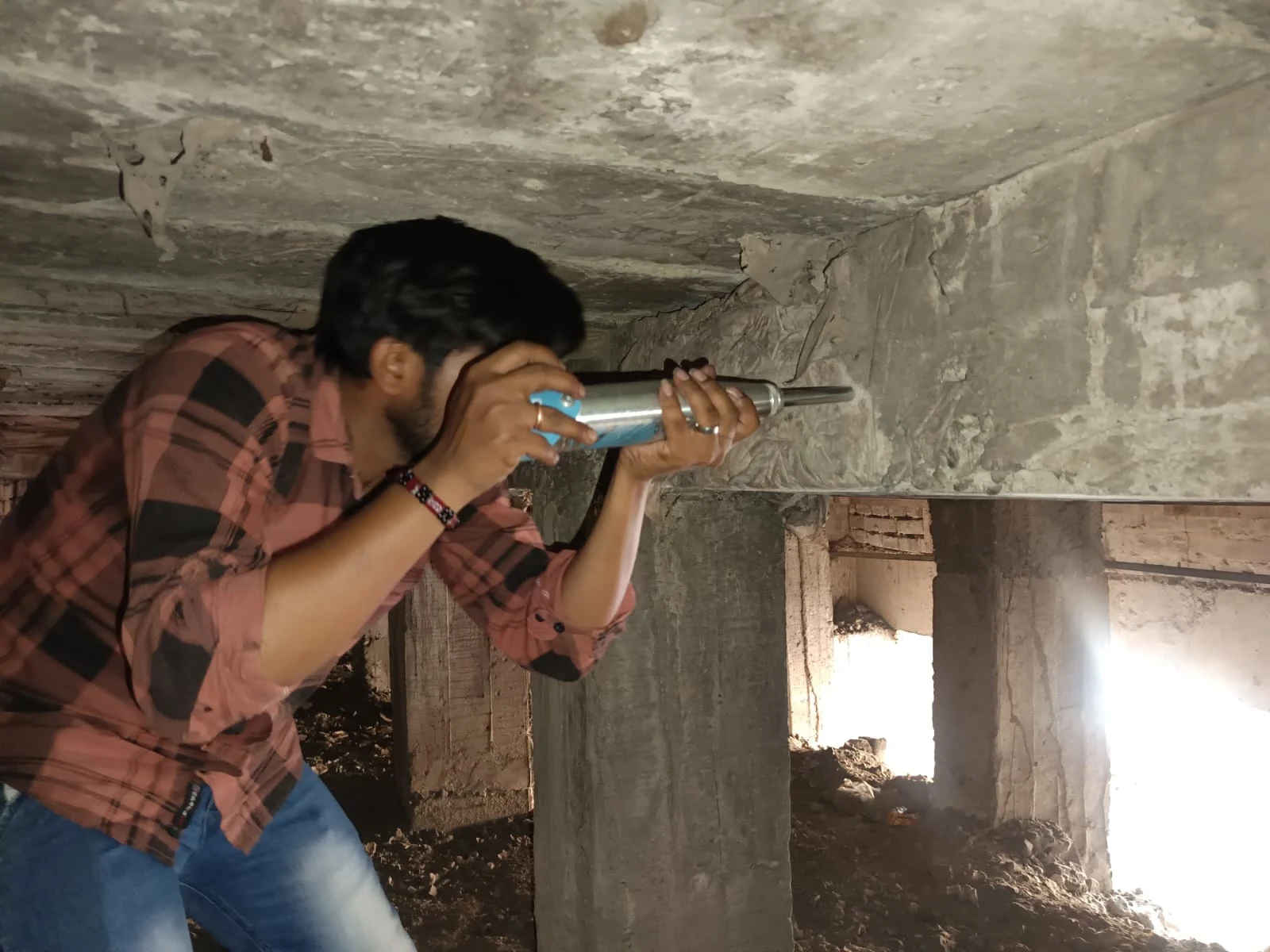
The selection of tests should be based on the observed defects and the questions that need to be answered.
Important: Rebound hammer results alone do not establish the in-situ compressive strength of concrete. UPV results also do not independently certify structural safety. Test results must be interpreted with other evidence and, where required, calibrated or supplemented by appropriate investigations.
Stage 4: Evaluate the structural system
The engineer should examine the structural arrangement, material condition, loading, support conditions and available design information.
Where necessary, structural analysis is undertaken to assess the building against relevant loading and performance requirements.
The assessment may also need to consider foundation condition, soil-related issues, changes in building use, seismic considerations and the effect of previous alterations.
Stage 5: Prepare a repair or strengthening strategy
After evaluating the available information, the engineer should identify the defects, their likely causes, the limitations of the investigation and the appropriate corrective measures.
Recommendations may include routine maintenance, localised repair, waterproofing, concrete rehabilitation, structural strengthening, retrofitting, further investigation or restrictions on use pending corrective action.
The repair specification should identify the scope of work, materials, preparation requirements, execution procedure, inspection and quality-control requirements.
Role of NDT and Structural Audit in Old Building Assessment
A structural audit combines condition assessment with appropriate investigation and engineering evaluation.
NDT can help identify variations in concrete quality, reinforcement location, cover and possible deterioration. Other tests may be required to investigate corrosion, material properties or specific defects.
The choice of test depends on the structural element and the problem being investigated. No single test provides a complete picture of an entire building.
For example:
Investigation method | What it can help assess | Important limitation |
|---|---|---|
Rebound hammer | Surface hardness and indicative concrete uniformity | Not a standalone measurement of in-situ compressive strength |
UPV | Concrete quality, uniformity and areas requiring further investigation | Interpretation depends on test arrangement, material and site conditions |
Cover meter | Reinforcement location and estimated concrete cover | Does not establish reinforcement strength or corrosion condition |
Half-cell potential | Probability of active reinforcement corrosion under suitable conditions | Does not directly measure corrosion rate or steel section loss |
Core testing | Local concrete sample properties | Local sampling may not represent the entire structure |
Visual inspection | Visible distress, damage and deterioration patterns | Cannot reveal every concealed defect |
A structural audit should interpret test findings alongside the visual survey, drawings, structural system, loading and engineering analysis.
The objective is not merely to produce test values. It is to determine what those findings mean for the building and what action is justified.
Repair, Rehabilitation or Strengthening: What Does the Building Need?
These terms are related but not interchangeable. The appropriate intervention depends on the nature and extent of the problem.
Intervention | Main purpose | Typical situation |
|---|---|---|
Maintenance | Prevent or control routine deterioration | Drainage, leakage prevention and protective maintenance |
Repair | Restore a damaged component or address a local defect | Localised concrete repair or crack treatment after diagnosis |
Rehabilitation | Improve the condition and functionality of deteriorated elements or systems | Wider deterioration affecting multiple building components |
Strengthening / retrofitting | Improve structural capacity or performance | Inadequate capacity, changed loading or identified structural deficiency |
A building may require more than one type of intervention. For example, concrete repair may need to be combined with corrosion mitigation and structural strengthening.
The final decision should follow engineering assessment rather than the contractor’s preferred repair product or method.
Special Considerations for Old Buildings in Kolkata and West Bengal
Buildings in Kolkata, Howrah and other parts of West Bengal may face deterioration associated with prolonged moisture exposure, leakage, inadequate drainage, ageing waterproofing systems and environmental conditions.
From our engineers’ experience: much of Kolkata stands on soft clay. If a structure is under-designed, or its foundation settles unevenly, the effects can take a few years to appear as cracks — even in a G+1 or G+2 building. Any building that shows cracks or other visible distress, and any building more than 15 years old, should have a structural audit before major repair work.
In some locations, site-specific ground and foundation conditions, established through soil investigation, may also be relevant when settlement or movement is observed.
However, the cause of a defect should never be assumed merely from the building’s location or age.
For example, a crack in an old building in Kolkata does not automatically indicate foundation settlement. Similarly, dampness does not automatically mean that the structural concrete has lost its capacity.
The investigation should consider the actual site, building history, structural system, exposure conditions and observed evidence.
Buildings in other parts of India, including coastal, industrial, high-rainfall and seismic regions, may require different assessment priorities depending on their exposure and structural characteristics.
Cost and Risks of Repairing Without Proper Assessment
Starting repair work without identifying the cause can create financial and technical problems.
The immediate repair cost may appear lower because investigation and engineering design are avoided. However, if the repair fails or the underlying deterioration continues, owners may have to pay again for removal, rework, additional testing, strengthening and disruption.
Without proper assessment | With engineering assessment |
|---|---|
Repair may target visible symptoms only | Investigation helps identify probable causes |
Concealed deterioration may remain undetected | Further investigation can be directed to suspect areas |
Repair materials may be selected without adequate diagnosis | Repair methods can be specified for the actual condition |
Additional work may be discovered during execution | Scope and uncertainties can be identified earlier |
Structural modifications may be undertaken without capacity checks | Proposed changes can be evaluated before implementation |
The financial impact varies from building to building. The purpose of assessment is not to guarantee that every repair will be cheaper, but to support informed decisions, reduce avoidable rework and address safety-related concerns appropriately.
For housing societies, a documented assessment also helps committees explain the proposed work to residents, compare contractor quotations on a technical basis and plan repair priorities.
When Should a Structural Consultant Be Engaged?
A structural consultant should be involved before major repair, rehabilitation, strengthening or structural alteration.
Professional assessment is particularly important when:
- Cracks are recurring, progressive or present in structural members.
- Concrete is spalling or reinforcement is exposed.
- Corrosion or visible section loss is suspected.
- There are signs of settlement, tilting or unusual deformation.
- Additional floors, tanks, machinery or other heavy loads are proposed.
- The building is being purchased, renovated or converted to a different use.
- A major repair contract is being considered.
- The building has experienced fire, flood, earthquake or impact damage.
If there is sudden movement, falling concrete, significant deformation or another indication of immediate danger, people should keep away from the affected area and seek urgent assessment by competent professionals and the relevant local authorities. Do not attempt an informal repair while the condition remains uncertain.
Frequently Asked Questions
Is it safe to repair an old building without a structural assessment?
It may be unsafe to undertake major structural repairs without understanding the building’s condition and the cause of deterioration. Minor routine maintenance may not require a full structural audit, but cracks, spalling, corrosion, settlement or structural alterations should be evaluated before selecting a repair method.
When should an old building undergo a structural audit?
A structural audit should be considered when visible distress develops, defects recur, concrete deteriorates, reinforcement corrodes, the building is altered or additional loads are proposed. It is also useful before major renovation or purchase where structural condition is an important consideration.
Can cracks in old buildings be repaired without identifying their cause?
Cracks should not automatically be filled or sealed without understanding why they developed. Some may be non-structural, while others may be associated with movement, corrosion, settlement or overloading. The cause, activity and structural significance should guide the repair method.
Is visual inspection sufficient before repairing an old building?
Visual inspection is an essential first step, but it may not reveal concealed deterioration or establish structural capacity. Depending on the findings, the engineer may recommend NDT, material testing, document review, measurements or structural analysis before preparing repair recommendations.
What is the role of NDT in assessing an old building?
NDT provides useful information about concrete uniformity, surface hardness, reinforcement location and possible deterioration. Tests such as rebound hammer and UPV can support an assessment, but their results must be interpreted with other evidence. No single NDT result establishes the overall safety of a building.
Can reinforcement corrosion make an old building unsafe?
Significant reinforcement corrosion can reduce steel cross-section, impair bond and contribute to concrete cracking or spalling. Its structural significance depends on the extent and location of corrosion, member capacity and loading. Proper investigation is necessary before deciding whether repair or strengthening is required.
Can an old building safely accommodate additional floors?
The age of a building or its previous ability to carry existing loads does not establish its capacity for additional floors. The structural system, foundations, material condition, existing loads and proposed changes must be evaluated by a competent structural engineer before construction is considered.
Who should assess an old building before major repair work?
A qualified structural engineering professional with relevant experience in existing-building assessment, material investigation and rehabilitation should lead the assessment. Depending on the problem, the work may also require geotechnical input, specialised testing, architectural coordination and other technical expertise.
Conclusion: Assess First, Repair Correctly
Repairing an old building is not simply a matter of applying new plaster, filling cracks or covering damaged concrete. The important task is to understand why the deterioration occurred and whether the existing structure can continue to perform safely under its intended use.
A systematic assessment helps building owners distinguish between routine maintenance, localised repair, rehabilitation and structural strengthening. It also provides a technical basis for defining the repair scope and monitoring the work.
For housing societies, building owners, developers and contractors, the practical principle is straightforward: do not select a major repair method before understanding the condition of the structure.
BS Projects & Engineers Pvt. Ltd. (BSPEPL) provides structural health monitoring and assessment, NDT and related structural engineering consultancy to support condition evaluation and technically appropriate repair and rehabilitation planning.
Assess first, repair correctly. Talk to our engineer.
WhatsApp / Call: 98304 83074 | 98307 37826 · Email: hello@bspepl.com
Learn more about our structural audit services in Kolkata.