

WhatsApp us | Call +91 98304 83074 | Send an Enquiry
Every structure finally transfers its load to the ground. In many parts of West Bengal the soil is soft clay, loose filled ground or expansive soil that cannot safely carry that load, or that settles too much over time. Sometimes even a single-storey building is at risk.
Ground improvement makes weak soil stronger and stiffer, so that the structure can stand on it safely. Often it is far more economical than a deep foundation. BS Projects & Engineers Pvt. Ltd. designs ground improvement solutions based on our own soil investigation and laboratory testing.
Developers, industries, architects and engineers in Kolkata, Howrah and North and South 24 Parganas come to us when the soil is too weak for a simple foundation. We compare ground improvement methods, such as preloading with vertical drains, stone columns and sal bullah piling, with a deep foundation, and recommend the option that is safe and economical for the site.
When Ground Improvement Is Needed
- Low bearing capacity of the soil
- Excessive or uneven settlement expected under the load
- Soft clay or marshy ground, common in many parts of South Bengal
- Loose or recently filled ground
- Expansive soil that swells and shrinks with moisture, causing cracks
- Embankments, roads, yards and storage areas on weak soil
Ground Improvement Methods We Design
- Preloading (static consolidation) – placing a surcharge load to consolidate soft clay before construction.
- Prefabricated vertical drains (PVD) and sand drains – shortening drainage paths so that consolidation happens in months instead of years.
- Dynamic compaction – densifying loose granular soils and filled ground with repeated heavy impact.
- Stone columns (stone piling) – columns of compacted stone that strengthen soft soil, reduce settlement and speed up drainage.
- Sal bullah piling – timber piles widely used for light structures on soft clay in West Bengal.
- Lime and cement stabilisation – improving the strength of soft and expansive clays, and of road subgrades.
- Geosynthetics and geotextiles – reinforcement, separation and drainage for embankments, roads and retaining walls.
- Grouting – filling voids and strengthening soil by injecting cement or chemical grout.
- Micro-piles – small-diameter piles for restricted sites and for strengthening existing foundations. Pile capacity can be confirmed with a pile load test.
Our Process
- Soil investigation – boring, field tests and laboratory testing to understand the problem.
- Option study – comparing suitable methods for safety, cost and time.
- Design – detailed design of the chosen method, with drawings and specifications.
- Quality control – inspection during execution.
- Verification – load testing and settlement monitoring, where required, to confirm the improvement.
Investigation Comes First
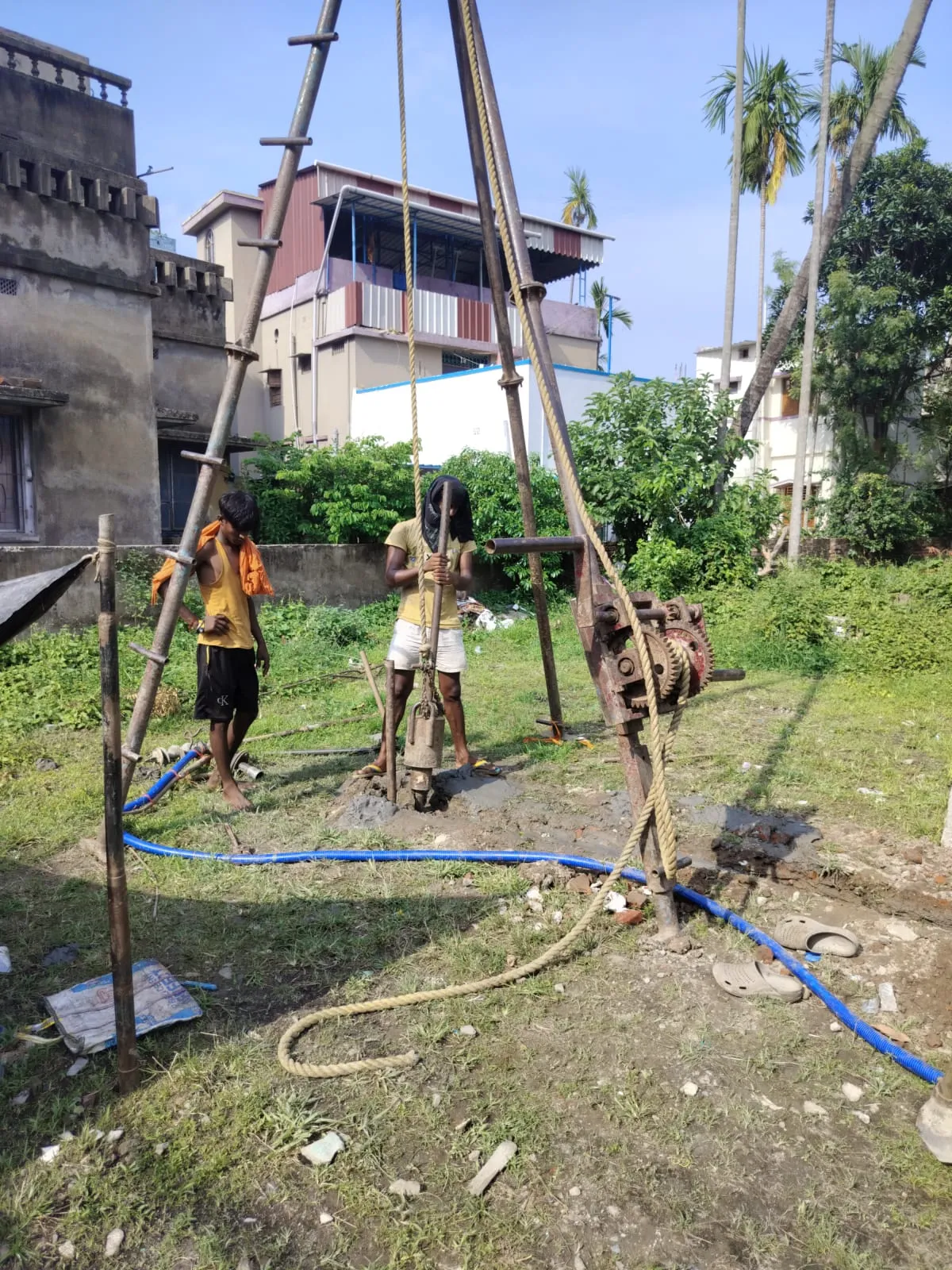 Boring at site | 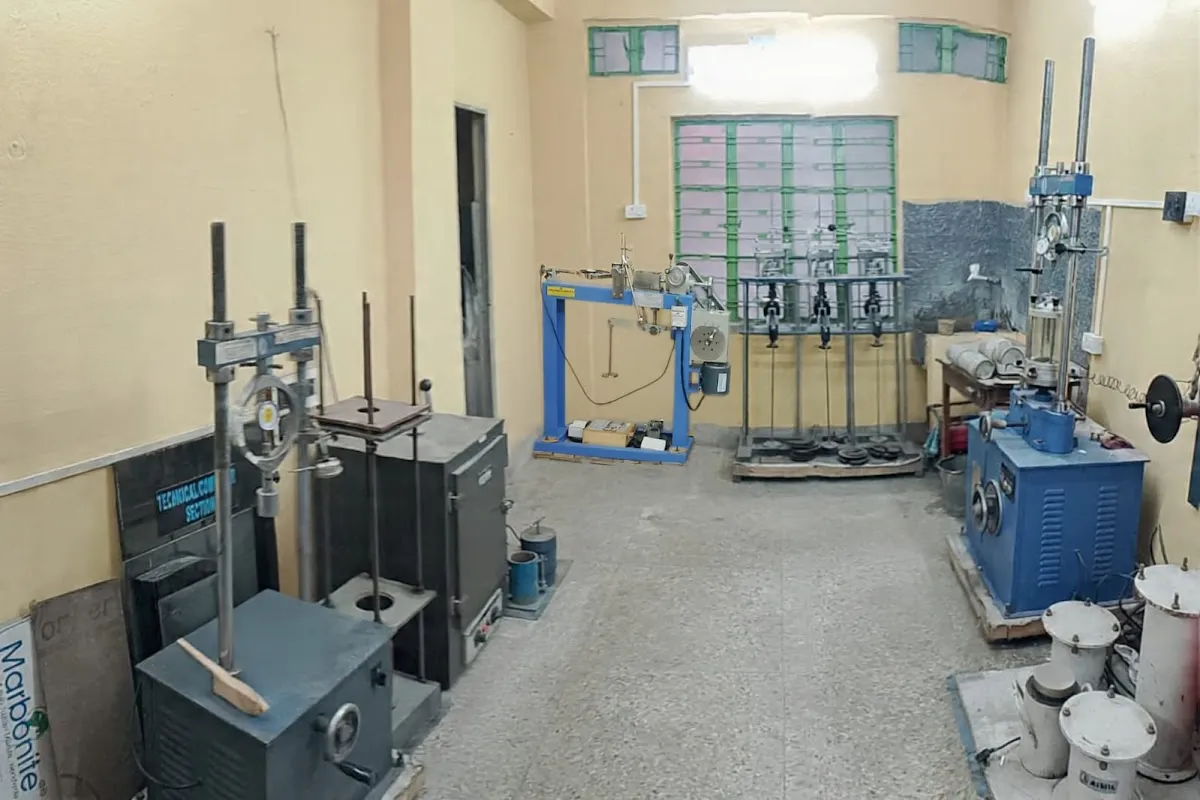 Our soil testing laboratory |
Every ground improvement design starts from real soil data from our geotechnical investigation.
Why BS Projects & Engineers
- Working since 2002 in geotechnical and structural engineering
- Own soil testing laboratory
- Investigation, ground improvement and foundation design under one roof
- Solutions chosen for safety and economy
Frequently Asked Questions
Is ground improvement cheaper than piling?
Often it is, especially for large areas and moderate loads. The right choice depends on the soil and the structure, which we compare in the option study.
Can ground improvement stop cracks caused by expansive soil?
It can greatly reduce them. Lime or cement stabilisation and proper foundation design control the swelling and shrinking that cause cracks.
Do I need a soil investigation first?
Yes. The method and design depend on the soil properties, so investigation always comes first.
Which ground improvement method is right for my site?
It depends on the soil type, the depth of the weak layer, the load of the structure and the time available. Our recommendation comes from the soil investigation: for example, preloading with vertical drains suits thick soft clay where time allows, while stone columns or micro-piles suit sites that must be built on sooner.
Which areas do you cover for ground improvement?
We are based in Kolkata and take up ground improvement work in Kolkata, Howrah, North and South 24 Parganas and across West Bengal.
Request a Ground Improvement Consultation
Call or WhatsApp +91 98304 83074, email hello@bspepl.com, or fill in our enquiry form.